pantin

Examples

Twenty-nine projects come with pantin, each made to show one thing, which its card names. The application opens on a start screen where all of them play; click one there to open it, and move the pointer over it to see its bones. Here they are as pantin render draws them.

A knight in armour with a sword, a shield and a red cape, striking a rising blow

duelist

A character for a game, whole. Everything a game asks of one character: thirteen animations (idle, walk, run, jump, fall, land, a combo of three attacks, block, crouch, hurt, die), legs on IK, a cape and a plume on springs, boxes that strike, are struck and guard, events, points, a draw order keyed while the shield is up, and a graph of thirteen states that eight parameters drive. Made by an agent through the MCP. In the manual →

For a game
A stickman walking

stickman

A walk that loops. Six bones and a walk of one second that loops, an event at each step. The smallest project that moves, and the one the first tour opens. In the manual →
Animation
A clock hopping on letters

bounce

Curves. A ball that is a clock hops onto the letters of pantin: each hop is a key on a curve that eases out and in, the squashes are scale keys, and its hand turns by stepped keys. In the manual →
Animation
A pendulum swinging

pendulum

Overlap. The rod and the weight have the same keys; the weight plays them a quarter of a second later, by an offset on the chain and no key moved. Turn the step of Overlap to see it change. In the manual →
Animation
A tree in the wind

tree

Shear. The trunk leans in the wind with its foot flat on the ground, which a rotation would lift: shear keys. In the manual →
Animation
Four flags on a turning plank

inherit

What a bone inherits. Four flags on a plank that turns and stretches, each inheriting in one of the four ways: everything, translation only, no rotation, no scale. In the manual →
Bones and constraints
Legs that bend while the feet stay

planted

Inverse kinematics. The hips are the only bone with keys; each leg is a chain of two bones that reaches for a foot, so the feet stay planted and the knees bend. In the manual →
Bones and constraints
A rubber arm stretching for a balloon

grabber

An IK that stretches. A rubber arm reaches for a balloon further than it is long: its constraint stretches the bones, thinner as they lengthen, and slows softly before the arm is straight. Its mix is keyed: it lets go a moment. In the manual →

Bones and constraints
A cart rolling on a road, its wheels turning

cart

A number that drives another. Only the cart is keyed. Its wheels turn as it rolls, their rotation given by its position; the needle of its dial is driven the same way, and stops at the ends of the dial. In the manual →

Bones and constraints
A face turning towards where its eyes look

face

A slider. Only the eyes are keyed. A slider holds another animation, the face turning, at the time the eyes give: the face turns towards where it looks by itself. In the manual →

Bones and constraints
An inchworm stretching along a twig

worm

Bones spaced and stretched along a path. An inchworm on a twig: its segments span a share of the path, each lengthened to the next, so it stretches out and draws together as that share is keyed. In the manual →

Bones and constraints
An owl watching a fly

eyes

A transform constraint. Only the fly is animated. Each pupil of the owl takes a twelfth of where the fly goes, by a transform constraint with no rotation, scale or shear: the owl watches it. In the manual →

Bones and constraints
A hand pushing the first of eight dominoes, which fall one on the next

dominoes

Events, made by an agent. A man pushes the first of eight dominoes, which fall one on the next: the first project made by Claude through the tools of the MCP alone. The arm reaches by a constraint, each finger has a bone for each joint, the fall comes from a simulation, and each domino tells an event as it strikes the next. Pantin for an agent →

Animation
A jellyfish whose tentacles trail behind its bell

jelly

Springs keyed in time. The tentacles of a jellyfish are springs with no key of their own; for its second pulse they are keyed four times as heavy, and trail later and further. In the manual →

Bones and constraints
A crane lifting its boom

crane

Springs. The boom rises and falls; the hook has no key: it swings on a spring under a cable that keeps hanging down. In the manual →

Bones and constraints
A desk lamp lighting a ball

lamp

Blend modes. The light of the lamp is an image whose slot adds it to what is behind: where it falls, the wall, the desk and the ball light up. Its arms reach by inverse kinematics. In the manual →

Images
A moon going round a ringed planet

orbit

Keys of the draw order. A moon goes round a planet and its ring: two keys of the draw order put it behind them, then in front. In the manual →

Animation
A knight, then a wizard

outfits

Skins. One character in two outfits: the default skin is a knight, the skin wizard has a robe, a pointed hat and a staff of the same names. A skin is not keyed, a game chooses it: here it changes during the spin at each lap. In the editor, choose it in Skins › Shown, at the bottom of the right panel. In the manual →

Images
Fish passing a porthole

porthole

A mask. A circle on the window cuts the sea and the fish drawn after it: they are seen only through the glass. Turn the mask off and the fish swim over the hull. In the manual →

Images
A campfire burning

campfire

A sequence of images. The flame is six images played one after the other, ten a second; the small flame plays the same images from another one. In the manual →

Images
A cannon firing

cannon

A point for a game. A point at the mouth of the barrel says where the ball leaves and in which direction, for a game to read; the animation tells it fire. In the manual →

For a game
A robot waving

robot

A graph of states. A robot that idles and waves when it is told hello: two animations, and a graph of states that fades from one to the other. Its antenna is on a spring. In the manual →

For a game
A flag waving

flag

A mesh. One image cut into a grid of 8 by 3 cells that hangs from a chain of four bones; each column follows the bone above it. In the manual →

Images
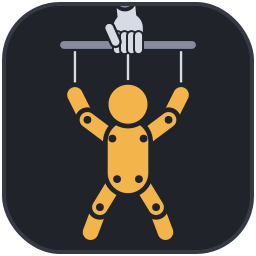
The puppet of the logo jumping

logo

Strings that stretch. The logo of pantin: each of its three strings is a mesh whose top follows the hand and whose bottom a wrist or the head, so it stretches. In the manual →

Images
A banner waving, red then blue

banner

A linked mesh. A banner that ripples and, halfway, shows its other side: another image that bends as the mesh of the first one, by the same bones and the same keys of its vertices. In the manual →

Images
A face that nods

turn

Parameters that deform meshes. A face whose eyes, nose and mouth slide to one side by a parameter, turn, that a game or a graph sets: open the tab Deform and move its slider. In the manual →

Images
A fish swimming

fish

Keys of the vertices of a mesh. The body is one mesh bent along a spine of four bones while a wave runs down it; keys of its vertices make the head swell as the fish breathes. In the manual →

Images
A snake going round a winding trail

snake

A path. The ten bones of a snake are laid along a closed trail that winds in and out, and one key of its position takes them once round. In the manual →

Bones and constraints
A striped tail wagging

tail

Weights. One image cut into triangles along a chain of four bones; each vertex near a joint is shared by the two bones there, so the tail bends instead of breaking. In the manual →

Images

Every example is a project folder in examples/ of the repository. Open one with cargo run -p pantin-app -- examples/eyes.pantin, or from the start screen. What each one shows, and how to read it →